
Global Money Week: “Smart Money Talks” Event to Encourage Open Conversations About Money
On March 17, the VMU Faculty of Economics and Management will host the event “Smart Money Talks” as part of Global Money Week. The initiative is organized by VMU FEM together with the VMU Investment Club, contributing to the activities supported by the Bank of Lithuania, which aim to strengthen financial literacy in society.
Facebook Event: https://www.facebook.com/events/879731445048994
Global Money Week is an international initiative held in many countries around the world to encourage open conversations about money, financial decision-making, and responsible financial management. This year’s global theme is “Talk About Money – Without Taboo,” inviting people to discuss finances openly, share experiences, and learn from real-life financial stories.
For several years now, VMU has been contributing to these initiatives through the efforts of Assoc. Prof. Dr. Asta Gaigalienė and Dr. Gintarė Leckė, who actively work in the field of financial literacy and involve the student community in educational activities. This year, the rapidly growing VMU Investment Club is also playing an important role in organizing the event, while its members continue to share their personal stories and experiences about money and investing on social media.
Conversations on Investing and Personal Finance
During the event “Smart Money Talks,” participants will hear from two finance professionals who will approach financial topics from different perspectives: investing and personal finance.
The first speaker, Lukas Jakubonis, is an investor, lecturer at the Vilnius University Business School, and former regulator and Chief Business Development Officer at the Bank of Lithuania. In his talk “Allergic to Crypto? Go Value Investing,” he will explore investment decisions through the lens of value investing and critically reflect on current investment trends.
The second presentation will be delivered by Simonas Radzevičius, founder of the VMU Investment Club and a personal finance consultant. In his talk “Personal Finance Failures,” he will share real-life stories about financial mistakes and discuss how learning from them can lead to better financial decisions.
Event Information
- Date: March 17
- Time: 15:00–16:30
- Location: VMU, Daukanto St. 28, Room 403
Program:
-
15:00–15:10 – Intro speech
-
15:10–15:50 – “Allergic to Crypto? Go Value Investing” – Lukas Jakubonis
-
15:50–16:30 – “Personal Finance Failures” – Simonas Radzevičius
The VMU Faculty of Economics and Management invites students and everyone interested in finance to join this open conversation about money — without taboo.
Event is in English.
Assoc. Prof. Dr. Asta Gaigalienė Appointed to the National Council for Economics and Entrepreneurship
Assoc. Prof. Dr. Asta Gaigalienė, lecturer at the VMU Faculty of Economics and Management and researcher at the Vytautas Kavolis Transdisciplinary Research Institute, has been appointed as a member of the Council for the subject of Economics and Entrepreneurship.
The composition of the subject councils has been officially approved by the Director of the National Education Agency (Order No. VK-90), marking an important step in strengthening the quality assurance of subject content at the national level.
The subject councils bring together teachers, researchers, and education experts with the aim of ensuring the quality, relevance, and alignment of curricula with contemporary societal and labor market needs. The field of economics and entrepreneurship is gaining increasing importance as financial literacy, entrepreneurial competence, and economic thinking become essential components of general education.
Assoc. Prof. Dr. Gaigalienė’s participation in the Council ensures that national decisions will be informed by an academic perspective grounded in both research and practical understanding of economics education. It creates an important bridge between the university and the general education system — connecting research, higher education, and school-level learning.
This appointment further strengthens the role of the VMU Faculty of Economics and Management in shaping national education policy and contributing to the development of high-quality economics and entrepreneurship education in Lithuania. The University thus acts not only as a place of knowledge transmission, but also as an active contributor to educational policy and curriculum development.
Economics and Entrepreneurship Exam: VMU FEM to Provide Free Preparation Support for Lithuanian Students
Vytautas Magnus University has been organizing free preparatory courses for various state matriculation exams for several years. This year, the VMU Faculty of Economics and Management (FEM) joins the initiative by offering, for the first time in Lithuania, a specially designed program for the Economics and Entrepreneurship state exam.
As the popularity of this exam continues to grow among 11th and 12th grade students, the FEM team has developed a focused, structured, and practice-based preparation cycle. The courses will be completely free of charge and are planned to be delivered in a hybrid format — with some sessions held in person and others online — allowing a wider group of students to benefit from the initiative.
The consultations, taking place in March and April, will be led by VMU FEM experts in macroeconomics, microeconomics, and finance. The program content has been prepared based on previous years’ exam tasks and consultations with teachers, aiming to help students prepare systematically, purposefully, and confidently.
Experts and Their Topics
The VMU Faculty of Economics and Management experts supporting students combine both academic and practical experience. Macroeconomics sessions will be led by Assoc. Prof. Dr. Jonė Kalendienė, a macroeconomics expert and Chief Economist at ILTE. Microeconomics preparation will be conducted by Dr. Monika Didžgalvytė-Bujauskė, Head of Bachelor Studies at VMU FEM and a specialist in microeconomics. Finance sessions will be delivered by Dr. Gintarė Leckė, who specializes in finance and applied financial decision-making.
Level I – 11th Grade Students
- Assoc. Prof. Dr. Jonė Kalendienė
- 📅 March 30 | ⏰ 15:30–17:00
- Macroeconomics – Key macroeconomic indicators and their interrelations
- Dr. Monika Didžgalvytė-Bujauskė
- 📅 April 3 | ⏰ 17:00–18:30
- Microeconomics – Market: demand, supply, and elasticity
- Dr. Gintarė Leckė
- 📅 April 13 | ⏰ 17:00–18:30
- Finance – Fundamentals of personal financial decision-making
Level II – 12th Grade Students
- Assoc. Prof. Dr. Jonė Kalendienė
- 📅 March 27 | ⏰ 15:30–17:00
- Macroeconomics – Real and nominal values. Economic policy and its effects
- Dr. Monika Didžgalvytė-Bujauskė
- 📅 April 1 | ⏰ 17:00–18:30
- Microeconomics – Market analysis and graphs. Changes in demand and supply, elasticity. Market structures: perfect competition and monopoly
- Dr. Gintarė Leckė
- 📅 April 16 | ⏰ 17:00–18:30
- Finance – Taxes and financial decisions in a global environment
Registration and Important Information
The number of places is limited; registration is mandatory. Registered participants will receive the link to join the online consultations via the email address provided during registration one day before the session.
Registration for each week’s courses is conducted separately. Registering for one week does not automatically grant access to sessions in subsequent weeks.
Registration phases:
- From March 16 – registration for March 23–27 courses
- From March 23 – registration for March 30 – April 3 courses
- From April 7 – registration for April 13–17 courses
Registration is possible up to 24 hours before the consultation begins. Registration closes once all places are filled.
📌 More information for 11th grade students:
📌 More information for 12th grade students:
14 VMU FEM teachers were ranked as the best in fall semester
The Fall semester of the 2025–2026 academic year marked an important recognition for the Vytautas Magnus University Faculty of Economics and Management (FEM) — 14 faculty members were ranked among the highest-rated lecturers during the fall semester, according to VMU’s official evaluation methodology.
This recognition is based on student evaluations and clear assessment criteria, demonstrating that classrooms at FEM are not merely spaces for delivering lectures, but environments of genuine academic dialogue, engagement, and responsible knowledge transfer.
Highest-rated VMU FEM lecturers
The following lecturers were named among the highest-rated at the Faculty of Economics and Management:
- Jolita Vveinhardt
- Renata Legenzova
- Gintarė Leckė
- Akvilė Aleksandravičienė
- Audrius Šimkus
- Khalil Israfilzade
- Miglė Šontaitė-Petkevičienė
- Asta Gaigalienė
- Aurelija Ganusauskaitė
- Aušra Pažėraitė
- Mantautas Račkauskas
- Asta Kamandulienė
- Eglė Stonkutė
- Monika Didžgalvytė-Bujauskė
These names represent more than a high evaluation score. They reflect consistent preparation, clearly structured teaching materials, respect for students, and the ability to make complex topics accessible and relevant.
Behind the results — clear standards
The evaluation was based on the following criteria:
- An overall teaching evaluation average of 9 or higher in the course;
- Student participation in the survey of 30% or more, with at least 10 respondents; or 25% or more when the course enrollment reached 100 students or more.
This means the results reflect not an isolated opinion, but the collective voice of the majority. A high rating in this case signals both trust and real impact in the classroom.
When quality becomes culture
Fourteen names on one list is no coincidence. It indicates that a high academic standard at FEM is not an exception, but a systemic culture. The Faculty is also home to many other strong lecturers who may have missed inclusion on this list by only a fraction of a point or a few survey responses.
At VMU FEM, classrooms bring together competence, preparation, and respect for the student. What is formed here is not merely a strong semester result, but a long-term competitive advantage for graduates — the ability to think critically, argue convincingly, and act professionally. That is the true value of academic quality.
The VMU International Debate Club joins Faculty of Economics and Management: a new home for intellectual leadership
The Vytautas Magnus University International Debate Club has officially become part of the Faculty of Economics and Management (FEM), marking an important step in strengthening the faculty’s academic culture and artes liberales tradition. From now on, the club will host its weekly meetings every Monday at 18:00 in the FEM coworking space, opening its doors to students eager to sharpen their thinking and communication skills.
This move reflects FEM’s broader vision: to educate not only specialists, but well-rounded individuals capable of thinking critically, communicating clearly, and leading with confidence in complex, international environments.
An international space for ideas, language, and leadership
As an English-only, international club, the International Debate Club creates a rare and valuable environment where international students and future global professionals meet on equal footing. Debate sessions go far beyond public speaking practice — they train structured reasoning, logical argumentation, attentive listening, and the ability to respond under pressure.
For students preparing careers in business, economics, finance, marketing, or management, these skills are not optional extras. They are foundational competencies for leadership in boardrooms, negotiations, policy discussions, and public forums, where clarity of thought and expression often determines outcomes.
Debate as a cornerstone of artes liberales education
Debate clubs are a long-standing pillar of the artes liberales tradition, which emphasizes broad intellectual development alongside professional expertise. At the world’s most prestigious universities — including Yale University, Harvard University, and University of Oxford — debate societies play a central role in shaping future leaders, diplomats, entrepreneurs, and academics.
Within this tradition, debate is not treated as a hobby, but as a discipline that connects logic, ethics, rhetoric, and real-world problem solving. By welcoming the International Debate Club into FEM, the faculty aligns itself with this global academic standard, where intellectual rigor and expressive clarity are cultivated side by side.
Club’s president: “It felt natural that the debate club should relocate to the Faculty of Economics and Management”
The relocation of the International Debate Club to the Faculty of Economics and Management was not a logistical decision, but a natural continuation of the club’s development and identity. From its earliest days, the club has been shaped by a clear mission: to create a space where students can grow, challenge themselves, and develop strong public-speaking and reasoning skills.
As the club expanded, it gradually became more than a training ground for speeches. It evolved into a community of like-minded individuals who actively compete in debate tournaments and engage in discussions spanning ethics, economics, and the humanities — areas that sit at the very core of the Faculty of Economics and Management.
As Taisa Vashkevich, President of the International Debate Club, explains:
“Debate club was born out of the idea to create a space for students to grow and develop their public-speaking skills. With time it became a hub of likely-minded individuals that compete in tournaments and lead discussions in various fields of ethics, economy and humanity. It felt natural that the debate club should relocate to the Faculty of Economics and Management. The goals of our club and the faculty align and, hopefully, we will be able to foster collaboration and support vibrant discussions in room 606 flowing.”
The move to FEM provides the club with an academic home that reflects its intellectual ambitions and offers an environment where debate, critical inquiry, and open dialogue are not only encouraged, but expected.
FEM’s commitment to debate and student growth
Reflecting on the importance of the club’s integration into the faculty, Paulius Bakanauskas, Vice-Dean for Marketing at FEM, emphasizes the strategic and academic value of debate:
“A strong debate club is not a luxury — it is a hallmark of a serious academic institution. The ability to articulate ideas clearly, defend arguments, and think critically has always been, and will remain, a cornerstone skill for future leaders in business, economics, finance, marketing, and management. Debate trains not only the mind, but also confidence, structure, and intellectual discipline.”
He adds that FEM sees the club not as an extracurricular add-on, but as an integral part of the faculty’s educational ecosystem:
“We are fully committed to supporting the growth of this club and invite all students who want to leave university with a truly elite, lifelong skill to join the International Debate Club.”
By becoming part of FEM, the International Debate Club gains a stable academic home — and the faculty gains a powerful platform for cultivating articulate, confident, and intellectually agile graduates ready to engage with the world.
Registration: https://forms.gle/vQmwArf5sZD778FF8
VDU FEM starts a partnership with the Kaunas branch of the Lithuanian Artists’ Association: art as part of artes liberales and investment thinking
The Faculty of Economics and Management of Vytautas Magnus University (VDU FEM) is starting a partnership with the Kaunas branch of the Lithuanian Artists’ Association (LDS KS) and, from February 1, 2026, is presenting a cycle of exhibitions by Kaunas city artists in the faculty spaces at K. Donelaičio St. 52, 6th floor.
This initiative in the FEM spaces sees art not only as an aesthetic object, but also as part of the artes liberales approach, where art becomes something that is analysed, reflected upon, and understood as an alternative form of value and investment.
THROUGH ART – TO UNDERSTAND VALUE CREATION
For a contemporary representative of business and economics, investing today means more than traditional asset classes – it is the ability to understand value creation, price logic, context, and risks, including those present in the art market.
Such an approach is widely applied in Western academic culture, where art at the university functions as a learning instrument, helping to connect economic thinking with cultural context. The aim of the exhibition cycle is to introduce the FEM community to Lithuanian artists and their work, while at the same time fostering a broader understanding of value, long-term thinking, and the relationship between economics and culture.
To learn more about how art acquires a price, read more here.
THE FIRST EXHIBITION IS PRESENTED BY INTERNATIONALLY RECOGNISED WATERCOLOUR MASTER DAIVA ŠLAJIENĖ
The first exhibition of this cycle in the FEM spaces presents the work of artist Daiva Šlajienė. The author has participated in more than 30 solo, group, national, and international exhibitions. Her poured watercolours stand out for their rich colours, professional pouring technique, complex compositions, and variety of subjects. In recent years, the artist’s works have received wide recognition both in Lithuania and within the international professional watercolour community.
In 2024, Daiva Šlajienė became the winner of the Best Artwork competition at the international art festival ART KAUNAS 2024 with the watercolour “Hide and Seek. Whim I”. In the same year, she was also awarded a diploma at the 10th International Watercolour Biennial “Baltic Bridges” for a watercolour diptych inspired by Danielius Dolskis’ work “In the Sea of Palanga”. In 2025, at the LDS Kaunas branch exhibition-competition “Kaunas Landscape”, the artist was awarded the Eglė Velaniškytė Prize for a deep and distinctive vision of the world and an authentic creative imprint.
THE EXHIBITED WORKS CAN BE PURCHASED
Award-winning works by the artist are also exhibited in the VDU FEM spaces, and visitors can view them and familiarise themselves with them before purchasing.
We sincerely thank the Kaunas branch of the Lithuanian Artists’ Association and Daiva Šlajienė for their collaboration and trust in jointly creating a living, thought-provoking initiative that enriches the academic space of the faculty.
“Autojuta” CEO Rasa Sinkevičienė: FEM trains your thinking, not gives you job instructions
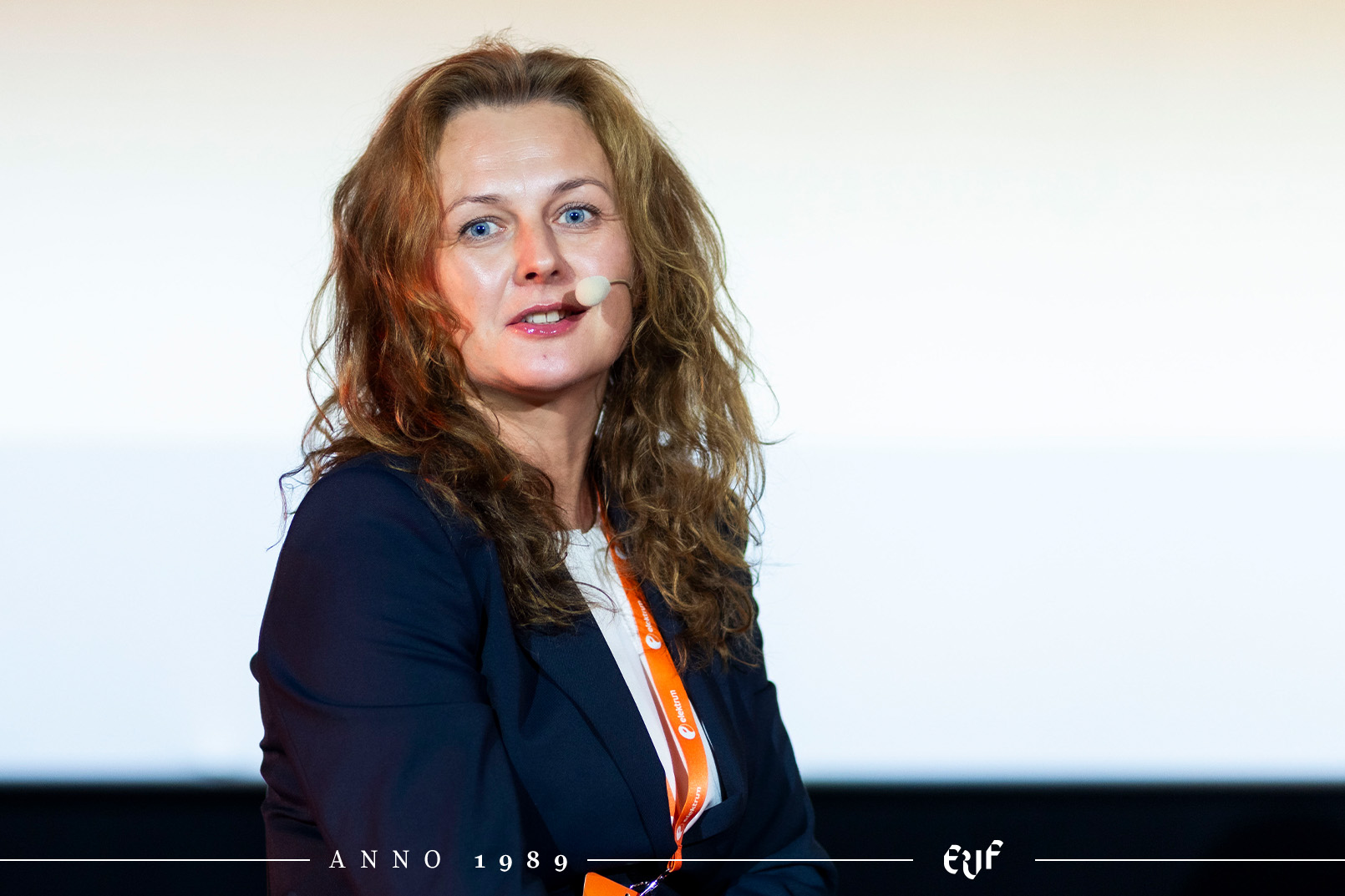
“Studies are not an instruction manual for life. They’re more like training for your thinking,” says Rasa Sinkevičienė, CEO of “Autojuta” and an alumna of Vytautas Magnus University’s Faculty of Economics and Management (FEM).
She entered VMU without a very specific plan, but today she describes that stage as one of the most important investments in herself. In her view, studies don’t help you “get a position” — they help you build a foundation: learn how to think, structure information, understand the world and yourself better, and then shape your own direction.
This conversation is about FEM studies as a way of developing thinking, about getting involved beyond the classroom, and about why a career is not a title, but what you do with genuine motivation.
FEM studies: training for your thinking, not instructions for a job
Sinkevičienė remembers coming to VMU without clear expectations. “I did well at school, so I had more than one option. At the time, the most popular choices were medicine, law, and economics. I couldn’t even consider medicine because I was afraid of blood, law seemed boring, and economics was a completely new field. So I decided to give it a try,” she recalls.
According to her, it’s perfectly normal to start studies without knowing exactly where they will lead. What matters is that, over time, you gain a deeper understanding of what a university truly gives. “My studies were very interesting and gave me a lot,” she says, stressing that their value often becomes clear only later.
She is straightforward: studies don’t make you a “ready employee” from day one. They shape your way of thinking, broaden your worldview, and develop the ability to organize information and make decisions. And how much you take from them depends greatly on your own engagement. “Nothing comes without work. Even geniuses work extremely hard to achieve something,” says Sinkevičienė.
Value is also created outside the classroom
Speaking about her student years, Rasa highlights what happens alongside lectures: activities, projects, organizations, and volunteering. In her view, that is where real growth often happens — when you take responsibility, deal with real issues, and learn to work with people.
“Volunteering says a lot about a person. When someone does work that nobody pays for, they reveal their best side — how they work, what their values are, what their character is like,” she says. Such experiences, she adds, not only strengthen you personally but also help you build relationships that last.
Sinkevičienė is glad that some of the connections and sense of community from her student years have continued to this day — she stays in touch with former classmates and like-minded people, and in some cases they work together or collaborate. For her, that is one of those quiet but powerful “returns” of university studies.
A minor and a wider perspective: business + psychology
During her studies, Rasa used the opportunity offered by VMU to choose a minor — alongside business she also studied psychology. “At first glance it may seem unrelated, but in reality both business and psychology are about people,” she says, emphasizing that better self-understanding automatically improves your ability to understand others.
She is convinced that combining different fields helps you see more broadly, which is especially important today, when professions and market needs are changing rapidly. In her view, a broad perspective and curiosity are not a “bonus” — they are becoming a necessity.
Rasa remembers the university as a space to try as much as possible — not to lock yourself into one narrow box, but to test what works, what interests you, what fits. “When you’re curious, everything is interesting,” she smiles, adding that investing in yourself works simply: the more you take from your studies, the more you gain.
A real career is doing what you enjoy
Sinkevičienė notices that young people often understand a career as a title: becoming a manager, a director, or owning a business. But she offers a different, more human definition. “A career is doing what you personally truly enjoy — and doing it exceptionally well,” she says.
In her view, the peak of a career may be not a position but mastery — if a person does something that feels meaningful. And the opposite is also true: there are many people with titles who feel unhappy because, in reality, they are not living their own life.
Her advice to young people is to take as much as possible from studies and life: be curious, think broadly, and don’t be afraid of work and involvement. “You may forget facts, but the ability to think, structure information, and make decisions remains — that’s what matters most,” says Sinkevičienė.
On other topics — leadership and working with people, the formula for business success, adapting to unexpected market changes (including COVID), views on artificial intelligence, and how mindset and beliefs affect outcomes — you can find the full article at vdu.lt.
VMU Faculty of Economics and Management Awards Best Business Idea at the Student Company eXpo
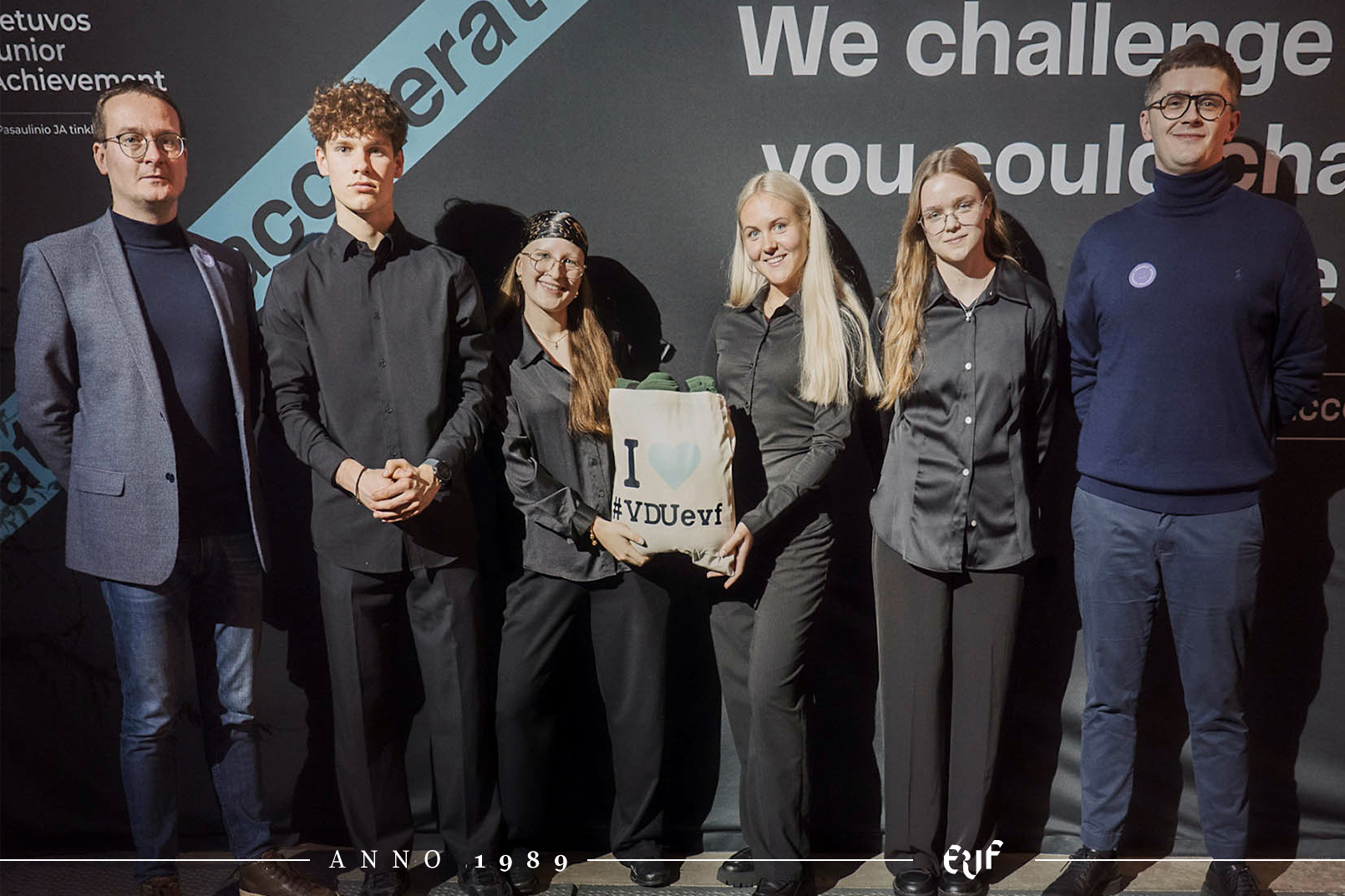
On December 12, 2025, the Student Company eXpo: Startup Jungle took place at the LITEXPO Exhibition Centrein Vilnius. The national event, organized by Lithuanian Junior Achievement, gathered hundreds of young innovators eager to showcase their most creative and ambitious business ideas.
This year’s eXpo featured an impressive 170 student companies (MMB) and more than 900 students from schools across Lithuania. The participants presented a wide range of concepts — from sustainable products and social business initiatives to technological solutions and educational platforms.
The Vytautas Magnus University (VMU) Faculty of Economics and Management (EVF) joined the event as a partner and established a special award for the best business idea presentation. Faculty Vice-Deans Assoc. Prof. Dr. Mantautas Račkauskas and Paulius Bakanauskas met with over thirty selected teams, evaluated their presentations, and selected the winner. The award went to the student company “Candeloro” from Kaunas Veršvai Gymnasium.
Students Impressed with Their Creativity and Business Logic
Before the exhibition began, the VMU EVF representatives selected the most promising student companies to meet in person. During the evaluations, several clear criteria were applied: the structure of the presentation (problem, solution, business model, impact, and team), persuasive communication, business model clarity, and the team’s confidence in their idea.
Many students impressed the jury not only with creativity but also with their ability to justify their projects using business logic, data, and market insights. Several teams had already conducted surveys, created prototypes, and even generated early sales — showing maturity well beyond their school years.
“We saw everything from original educational apps to ideas that could revolutionize the construction and automotive industries. The level of maturity and strategic thinking shown by the students was truly inspiring,” said VMU EVF Vice-Dean Assoc. Prof. Dr. Mantautas Račkauskas. “Many of these ideas have real potential to grow into successful businesses in both Lithuanian and international markets.”
According to the Vice-Dean, such initiatives demonstrate that young people are not only creative but also capable of thinking critically and structurally — essential qualities for any future entrepreneur.
The Winning Team Presented a Fully Functioning Business
After several hours of discussions and evaluations, the title of Best Business Idea Presentation went to “Candeloro”from Kaunas Veršvai Gymnasium. Their product — edible chocolate birthday candles — stood out because it was already a functioning business. During the event, the team not only presented their idea but also sold their products, attracting a long line of customers.
“The line of buyers itself became the strongest argument for choosing the winner,” said VMU EVF Vice-Dean Paulius Bakanauskas. “The students had prepared professional business and marketing plans, conducted market research, and were ready to answer every question. While the idea may seem simple on paper, its execution was highly professional — and the team was already generating real sales during the exhibition.”
The “Candeloro” project demonstrates that youth entrepreneurship in Lithuania is evolving rapidly — more and more students are creating viable business models and learning how to turn ideas into profitable ventures even before they enter university.
VMU Faculty of Economics and Management — Where Ideas Grow into Sustainable Ventures
Participation in the eXpo gave the faculty representatives valuable insights into how Lithuanian youth think about innovation and entrepreneurship, as well as what support and knowledge they need to develop their ideas further.
“Despite the impressive ideas we saw, we also recognized how universities can help — by providing theoretical knowledge, structure, and the strategic mindset necessary to build sustainable businesses,” said VMU EVF Vice-Dean for Studies Assoc. Prof. Dr. Mantautas Račkauskas. “If these student ideas were further developed at university using the knowledge gained in our programs, many could become truly successful ventures.”
The VMU Faculty of Economics and Management has been fostering an entrepreneurial culture since 1989, encouraging students to combine academic learning with real-world projects. Its programs equip young entrepreneurs with the knowledge and tools to build strong, evidence-based business strategies.
Learn more about Bachelor’s studies at the VMU Faculty of Economics and Management and become part of a community that has been shaping business leaders since 1989:
International Week at the Faculty of Economics and Management, VMU

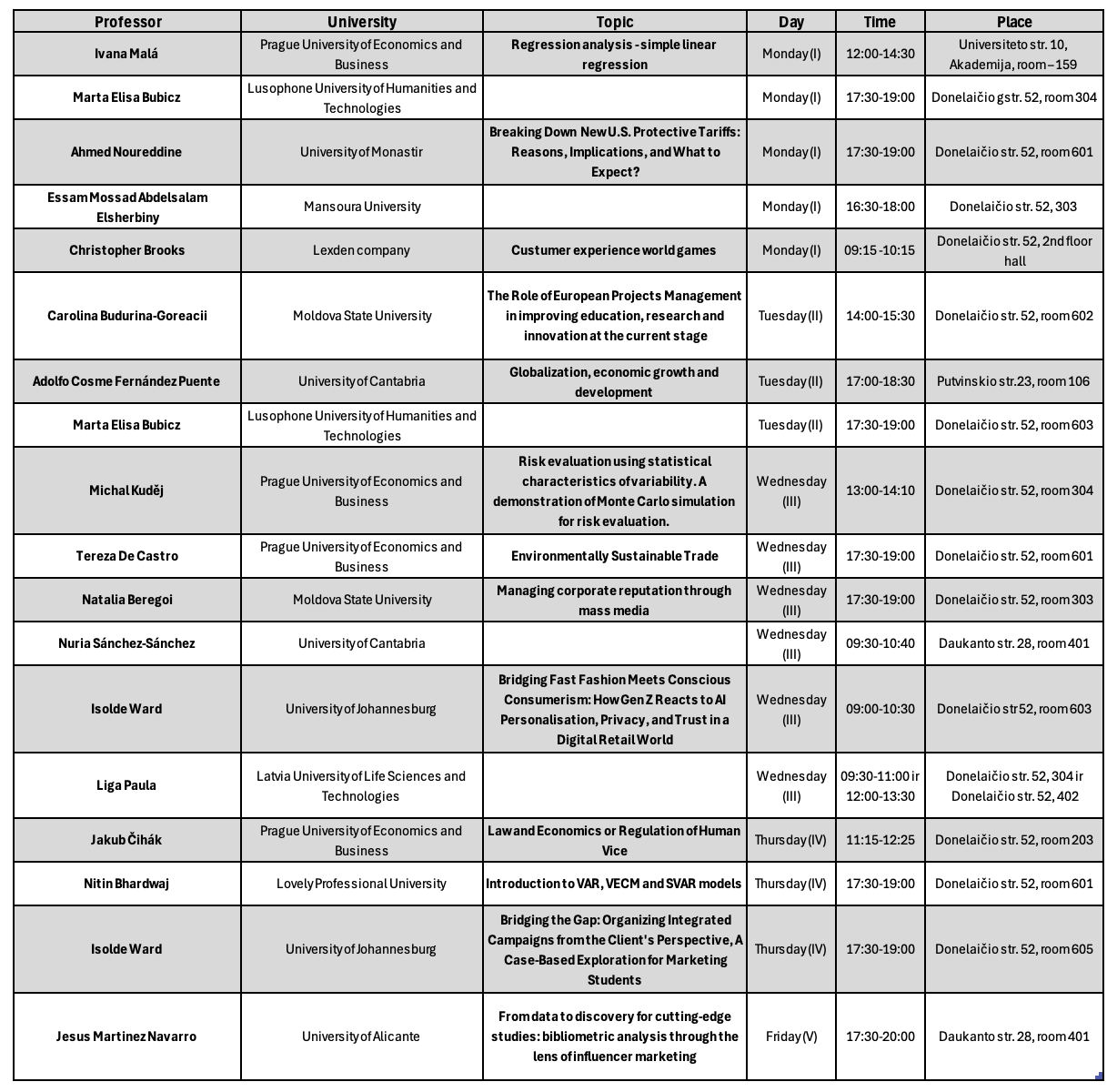
On May 5–9, 2024, the Faculty of Economics and Management of Vytautas Magnus University (VMU) will host an international week, during which lecturers from all over the world will give lectures to students.
This event is a unique opportunity for VMU students not only to listen to relevant lectures in English, but also to get acquainted with the experience of higher education and approaches to economics, management, marketing, finance and management in various countries.
This year, we will welcome guests from 11 countries around the world: the Czech Republic, Moldova, Spain, Portugal, India, Tunisia, Egypt, the Republic of South Africa, the United Kingdom, Poland and Latvia.
Lecturers from institutions such as the Prague University of Economics and Business, the University of Cantabria, the Moldovan State University, Lovely University of Applied Sciences, the University of Johannesburg, the Latvian University of Life Sciences and Technology, etc. will share their knowledge and experience with students.
You can find the week’s program here:
We invite you to actively participate in lectures, gain knowledge, and take advantage of the opportunity to establish international academic connections.
VDUevf researchers and partners seek innovative solutions for a more sustainable European glass industry